Storm and River Flood Cleanup in Olympia, WA
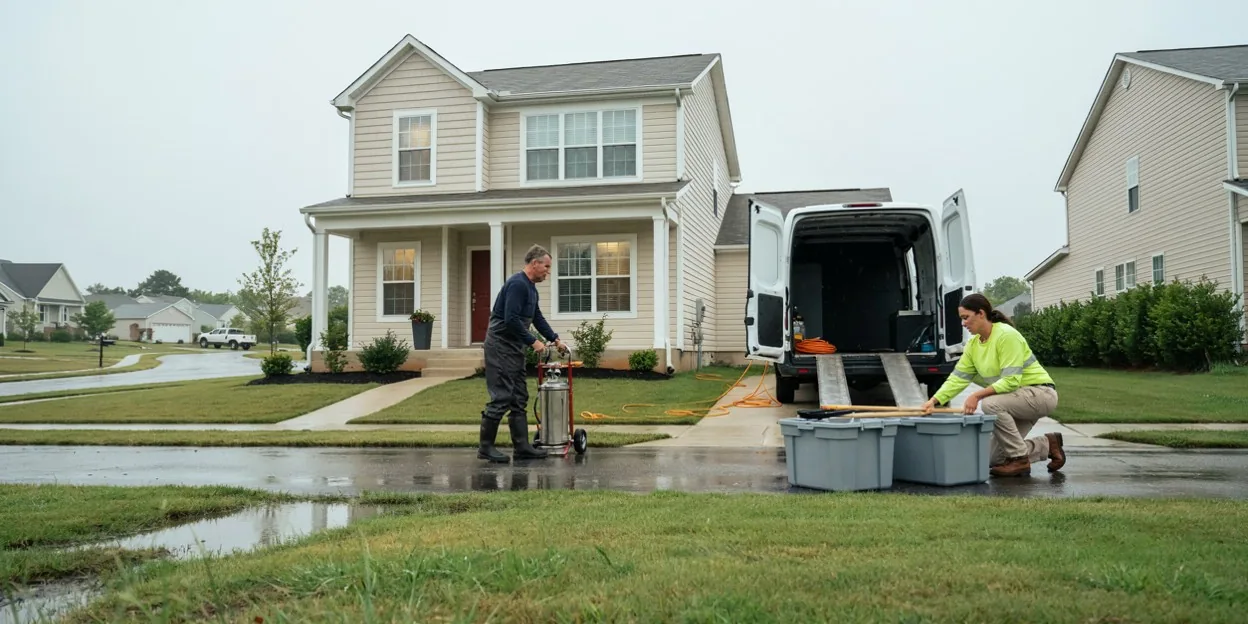
The river gauge at Rainier had been climbing all night, and by dawn the Deschutes was across the pasture and eight inches deep in the daylight basement of your Tumwater house. The water is brown, it smells like diesel and silage, and a line of mud marks the wall where it stopped. The rain has quit, but the river has not gone down. This site puts you through by phone to an independent local provider who cleans up after storm and river flooding in Olympia and across Thurston County.
Outside water is treated as contaminated, and the cleanup starts there
River and tidal water carries silt, fuel, farm runoff, sewage from overloaded drains, and whatever was in the yards upstream, so the crew treats every surface it touched as contaminated. They pump out the standing water, shovel and bag the mud, and then remove the porous materials the water reached: carpet and pad, drywall and insulation to a line above the high-water mark, cabinet bases, particleboard, and cardboard. Framing, concrete, and solid wood are cleaned, treated, and dried. Nothing porous that sat in floodwater is dried in place.
The crew works in protective gear and keeps the flooded rooms separated from the dry part of the house so mud and debris do not travel. They also check the crawl space, because a house that flooded at the floor almost always flooded underneath first.
Before you walk back into a flooded room
Wait until the water has stopped coming in and the power to that part of the house is off at the panel. Do not step into standing water that may have outlets, cords, or the furnace in it. Do not run the furnace or the well pump until someone has looked at them. Photograph the high-water line on the walls, the mud on the floor, and each room before anything is moved. Keep kids and pets out. Do not try to save carpet or drywall that sat in river water. Then call and say which river or which drain the water came from.
What is saved and what leaves the house
Concrete slabs, block walls, and framing lumber are cleaned and dried and stay. Solid wood doors, trim, and hardwood floors are judged one piece at a time; some dry and clean, many do not. Appliances that were under water are checked before they are plugged back in. Drywall, insulation, carpet, pad, laminate, particleboard cabinets, and upholstered furniture that sat in the water come out. The crew inventories and photographs what is removed so the list reaches your adjuster. After the tear-out, structural drying runs until the framing and slab are back to dry, and water extraction equipment handles any clean water that came in separately from the roof or a pipe.
The rivers, the storms, and the tide in Thurston County
Three rivers flood here. The Deschutes runs from the Bald Hills past Rainier and Tumwater to Capitol Lake, and it went over its banks in the storms of February 1996, December 2007, and January 2009. The Nisqually forms the county's east line past Yelm and flooded hard in November 2006 and January 2009. The Chehalis and its tributary the Black River cross the southwest corner through Rochester and Grand Mound, and the early December 2007 atmospheric river put the Chehalis across Interstate 5 for four days and into hundreds of Lewis and Thurston County homes. January 2009 closed the freeway again. The December 2015 and November 2021 storms saturated the same ground.
Downtown Olympia has a fourth source. The blocks around Capitol Way and Percival Landing sit on fill only a few feet above Budd Inlet, and a king tide coinciding with a low-pressure storm now pushes salt water up through the storm drains onto the streets several times a winter. Water that comes up through a drain is contaminated the same as river water, and the cleanup is the same.
Floodwater from a river, a tide, or surface runoff is excluded from a standard homeowner policy and is covered, if at all, under a separate flood policy. This site cannot say what you carry. The crew's photos of the high-water line and its inventory of removed material are what the flood adjuster works from.
Calling after the water came in from outside
Say which river, creek, or drain the water came from, how deep it got, and whether it has stopped rising. Mention if the crawl space or a daylight basement is involved and whether the power is off. Have the property address and a callback number within reach, and call (360) 364-8868.